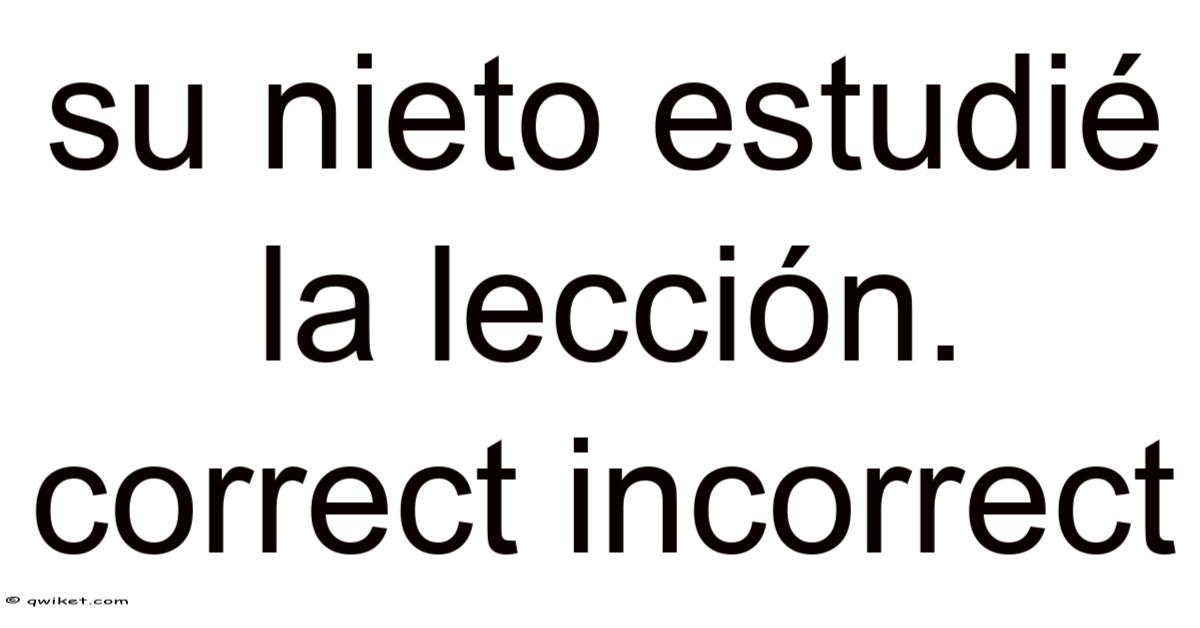
Su Nieto Estudió la Lección: Correct or Incorrect? A Complete Grammar Analysis
The sentence "su nieto estudié la lección" is incorrect. This Spanish sentence contains a fundamental subject-verb agreement error that even native speakers sometimes make when learning the language or speaking quickly. Understanding why this sentence is wrong will help you master one of the most important aspects of Spanish grammar: the relationship between the subject and the verb.
Understanding the Sentence Structure
To comprehend why "su nieto estudié la lección" is incorrect, we need to break down each component of the sentence:
- "Su nieto" means "his grandson" or "her grandson" — this is a third-person singular subject
- "Estudió" (written incorrectly as "estudié" in the sentence) means "he studied" or "she studied" — this is the third-person singular past tense form
- "La lección" means "the lesson" — this is the direct object
The critical issue lies in the mismatch between the subject and the verb form. Think about it: when you say "su nieto," you are referring to a third person (someone else's grandson), but "estudié" is the first-person singular form of the verb, which means "I studied. " This creates a grammatical contradiction that makes the sentence incorrect in standard Spanish Most people skip this — try not to. Nothing fancy..
The Spanish Verb Conjugation System
Spanish verbs are remarkably different from English verbs because they change their endings to match the subject. Also, this process is called conjugation, and it applies to almost every verb in the language. Understanding conjugation is essential for communicating correctly in Spanish.
In the preterite tense (used to describe completed actions in the past), the verb "estudiar" (to study) has the following forms:
| Subject Pronoun | Conjugation |
|---|---|
| Yo (I) | estudié |
| Tú (you informal) | estudiaste |
| Él/Ella/Ud. (he/she/you formal) | estudió |
| Nosotros (we) | estudiamos |
| Ellos/Ellas/Uds. (they/you plural) | estudiaron |
As you can see from this table, the verb ending changes dramatically depending on who is performing the action. The ending "-é" belongs exclusively to "yo" (I), while "-ó" belongs to "él/ella/usted" (he/she/you formal). This is why "su nieto estudié la lección" creates confusion — it mixes a third-person subject with a first-person verb ending.
Why Subject-Verb Agreement Matters
Subject-verb agreement is one of the most critical grammar rules in Spanish. The verb must always "agree" with its subject in both person (first, second, or third) and number (singular or plural). When these elements don't match, the sentence becomes grammatically incorrect and can even change the meaning entirely Simple as that..
In our problematic sentence, "su nieto" clearly indicates a third-person subject — someone else's grandson. This person is not "yo" (I), so using "estudié" (the "I studied" form) is fundamentally wrong. The sentence essentially says "his grandson I studied the lesson," which makes no logical sense in Spanish And that's really what it comes down to. Surprisingly effective..
Native Spanish speakers generally don't make this error in casual conversation because the mismatch sounds obviously wrong to their ears. On the flip side, learners of Spanish as a second language often struggle with verb conjugation, and errors like this are common among beginners and intermediate students Worth keeping that in mind..
The Correct Forms
Now that we understand the problem, let's look at the correct ways to express this idea:
If You Want to Say "His Grandson Studied the Lesson"
The correct sentence is: "Su nieto estudió la lección."
Here, "estudió" (with the -ó ending) correctly matches the third-person subject "su nieto." This is the proper form when referring to someone else's grandson completing the action of studying Worth keeping that in mind..
If You Want to Say "I Studied the Lesson"
If you are the one who studied, you would say: "Yo estudié la lección."
In this case, "estudié" (with the -é ending) is correct because "yo" is a first-person subject. Notice that when you explicitly include "yo," the verb form "estudié" becomes correct.
Other Correct Variations
- "El niño estudió la lección." (The boy studied the lesson.)
- "Mi hijo estudió la lección." (My son studied the lesson.)
- "Ella estudió la lección." (She studied the lesson.)
All of these use third-person singular subjects with the corresponding "estudió" verb form.
Common Causes of This Error
Understanding why this mistake happens can help you avoid it in your own Spanish writing and speaking:
1. Confusion between similar-sounding endings: The difference between "estudié" and "estudió" is just one letter, but it changes the meaning completely. The accent mark (tilde) on "estudió" is what distinguishes third person from first person in this case.
2. Transfer from English: English verbs don't change their endings based on the subject (except for the third-person singular "s" in present tense). Spanish learners sometimes forget to apply Spanish conjugation rules.
3. Memory lapses: When speaking quickly or under pressure, it's easy to grab the wrong verb form, especially if you're thinking about what you want to say next rather than focusing on grammar And it works..
4. Overgeneralization: Some learners hear "estudié" frequently (because "I studied" is a common sentence in language learning) and start using it everywhere, even when they should use "estudió."
How to Avoid This Mistake
Here are some practical strategies to ensure you use the correct verb form:
- Always identify your subject first before choosing your verb form. Ask yourself: Who is doing the action?
- Practice verb conjugation regularly until the correct forms become automatic.
- Listen to native speakers and pay attention to how they match subjects with verbs.
- Read extensively in Spanish to expose yourself to correct grammar patterns.
- Use language learning apps that provide immediate feedback on your verb usage.
Frequently Asked Questions
Is "su nieto estudió la lección" grammatically correct?
Yes, "su nieto estudió la lección" (with "estudió" instead of "estudié") is perfectly correct Spanish. The verb "estudió" correctly matches the third-person subject "su nieto."
What's the difference between "estudié" and "estudió"?
"Estudié" means "I studied" (first person singular), while "estudió" means "he/she studied" or "you formal studied" (third person singular). The accent mark on "estudió" is essential for distinguishing these two forms.
Can "estudié" ever be used with "su nieto"?
No, "estudié" cannot grammatically agree with "su nieto" because they represent different persons. "Su nieto" is third person, and "estudié" is first person. There is no context in which this combination would be correct.
How do I know which verb ending to use?
Match the verb ending to the subject pronoun: use "-é" for yo, "-aste" for tú, "-ó" for él/ella/usted, "-amos" for nosotros, and "-aron" for ellos/ellas/ustedes.
Does this rule apply to all Spanish verbs?
Yes, subject-verb agreement applies to all regular and most irregular Spanish verbs. The specific endings vary by verb type, but the principle of matching the verb to the subject remains the same.
Conclusion
The sentence "su nieto estudié la lección" is incorrect because it violates the fundamental Spanish grammar rule of subject-verb agreement. The subject "su nieto" (his/her grandson) is third-person singular, but the verb "estudié" is first-person singular, creating a mismatch that makes the sentence grammatically unsound It's one of those things that adds up..
The correct version is "su nieto estudió la lección", where "estudió" properly matches the third-person subject. This small change — adding the accent mark and changing the vowel from "e" to "o" — transforms an incorrect sentence into perfectly proper Spanish Most people skip this — try not to..
Mastering Spanish verb conjugation takes time and practice, but understanding the logic behind the rules makes the learning process much easier. Remember: always match your verb endings to your subject, and your Spanish will be clear, correct, and understood by native speakers everywhere.
