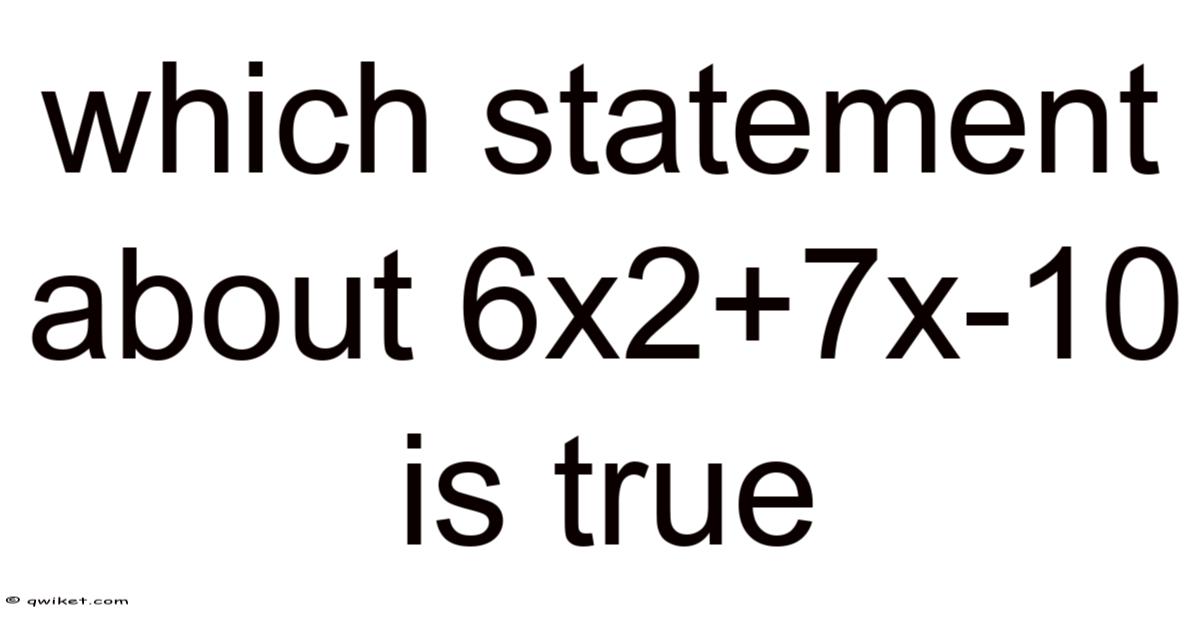
Which Statement About 6x² + 7x - 10 is True?
When faced with the quadratic expression 6x² + 7x - 10, students and math enthusiasts often find themselves searching for the "true statement" regarding its properties. Whether you are trying to find its factors, determine its roots, or identify its vertex, understanding this specific trinomial requires a solid grasp of algebraic principles. To determine which statement about 6x² + 7x - 10 is true, we must analyze it through various mathematical lenses: factoring, solving for x, and analyzing its graphical behavior.
Introduction to the Quadratic Expression
The expression 6x² + 7x - 10 is a quadratic trinomial. In algebra, a quadratic expression follows the standard form ax² + bx + c, where:
- a = 6 (the leading coefficient)
- b = 7 (the linear coefficient)
- c = -10 (the constant term)
Because the leading coefficient (a) is positive, we know that the graph of this equation is a parabola that opens upwards. The "truth" about this expression depends on what the question is asking—whether it is asking for the factored form, the zeros of the function, or the nature of its coefficients.
Factoring the Expression: The AC Method
One of the most common "true statements" regarding this expression concerns its factored form. To factor 6x² + 7x - 10, we use the AC Method (also known as factoring by grouping).
Step-by-Step Factoring Process:
- Multiply a and c: First, multiply the leading coefficient (6) by the constant (-10).
- 6 × -10 = -60.
- Find the Magic Numbers: We need two numbers that multiply to give -60 and add up to give the middle coefficient (7).
- Looking at the factors of 60: (1, 60), (2, 30), (3, 20), (4, 15), (5, 12).
- Since we need a sum of +7 and a product of -60, the pair 12 and -5 fits perfectly (12 - 5 = 7 and 12 × -5 = -60).
- Split the Middle Term: Rewrite the 7x using these two numbers.
- 6x² + 12x - 5x - 10
- Factor by Grouping: Group the first two terms and the last two terms.
- (6x² + 12x) - (5x + 10)
- Factor out the greatest common factor (GCF) from each group:
- 6x(x + 2) - 5(x + 2)
- Final Factored Form: Since (x + 2) is common to both terms, we can group the remaining coefficients.
- (6x - 5)(x + 2)
So, the statement "The factored form of 6x² + 7x - 10 is (6x - 5)(x + 2)" is a mathematically true statement.
Finding the Roots (Solving for x)
If the expression is set as an equation (6x² + 7x - 10 = 0), we can find the values of x, also known as the roots or zeros. Using the factored form we just discovered, we apply the Zero Product Property, which states that if the product of two factors is zero, at least one of the factors must be zero.
-
Setting the first factor to zero: 6x - 5 = 0 6x = 5 x = 5/6 (or approximately 0.833)
-
Setting the second factor to zero: x + 2 = 0 x = -2
Thus, any statement claiming that the solutions to the equation are x = 5/6 and x = -2 is true That's the part that actually makes a difference..
Using the Quadratic Formula for Verification
To ensure our results are accurate, we can use the Quadratic Formula, which works for any quadratic equation regardless of whether it is easily factorable: x = [-b ± √(b² - 4ac)] / 2a
Let's plug in our values:
- a = 6, b = 7, c = -10
- x = [-7 ± √(7² - 4(6)(-10))] / 2(6)
- x = [-7 ± √(49 + 240)] / 12
- x = [-7 ± √289] / 12
- Since √289 = 17, we have:
- x₁ = (-7 + 17) / 12 = 10 / 12 = 5/6
- x₂ = (-7 - 17) / 12 = -24 / 12 = -2
Most guides skip this. Don't Took long enough..
This confirms that our previous factoring was correct. The discriminant (the value under the square root, 289) is a perfect square, which proves that the roots are rational numbers.
Analyzing the Discriminant
In many multiple-choice questions, a statement might refer to the discriminant (Δ = b² - 4ac). * If Δ = 0: One real root (a double root). The discriminant tells us the nature of the roots:
- If Δ > 0: Two distinct real roots.
- If Δ < 0: Two complex (imaginary) roots.
For 6x² + 7x - 10, the discriminant is 289. Because of that, since 289 is greater than zero, the statement "The equation has two distinct real roots" is true. Beyond that, because 289 is a perfect square, we can specifically state that **"The roots are rational.
Graphical Characteristics of the Expression
If you were to graph the function $f(x) = 6x^2 + 7x - 10$, several true statements would emerge regarding its geometry:
- Y-Intercept: The y-intercept occurs where x = 0. Plugging 0 into the expression gives -10. So, the statement "The graph crosses the y-axis at (0, -10)" is true.
- X-Intercepts: As calculated earlier, the graph crosses the x-axis at (-2, 0) and (5/6, 0).
- Direction of Opening: Because the coefficient of x² (6) is positive, the parabola opens upward, meaning it has a minimum point rather than a maximum point.
- Vertex: The x-coordinate of the vertex is found using the formula $x = -b / 2a$.
- x = -7 / (2 * 6) = -7/12
- Plugging -7/12 back into the equation would give the y-coordinate of the vertex, representing the lowest point of the curve.
Summary of True Statements
In short, if you are looking for the correct answer in a test or a textbook, here are the various true statements regarding 6x² + 7x - 10:
- Factoring: The expression factors into (6x - 5)(x + 2).
- Roots: The zeros of the function are x = 5/6 and x = -2.
- Discriminant: The discriminant is 289, indicating two distinct rational roots.
- Intercepts: The y-intercept is -10.
- Graph: The parabola opens upward.
Frequently Asked Questions (FAQ)
Q: Is 6x² + 7x - 10 a prime polynomial? A: No. A prime polynomial is one that cannot be factored using integer coefficients. Since we successfully factored it into (6x - 5)(x + 2), it is not prime.
Q: How do I know if the roots are rational or irrational? A: Look at the discriminant. If the discriminant is a perfect square (like 289), the roots are rational. If it were a number like 287, the roots would be irrational.
Q: What happens if the sign of the constant was +10 instead of -10? A: If the expression were 6x² + 7x + 10, the discriminant would be $7^2 - 4(6)(10) = 49 - 240 = -191$. In that case, the roots would be complex/imaginary, and the graph would never touch the x-axis.
Conclusion
Understanding the expression 6x² + 7x - 10 is a great way to practice the fundamental pillars of algebra. Practically speaking, by applying the AC method for factoring, the quadratic formula for solving, and the discriminant for analysis, we can uncover every mathematical truth about the expression. Whether you are identifying its factors as (6x - 5)(x + 2) or its roots as -2 and 5/6, the key is to approach the problem systematically. By breaking the expression down into its coefficients and applying standard formulas, you can confidently determine which statement is true and why.
