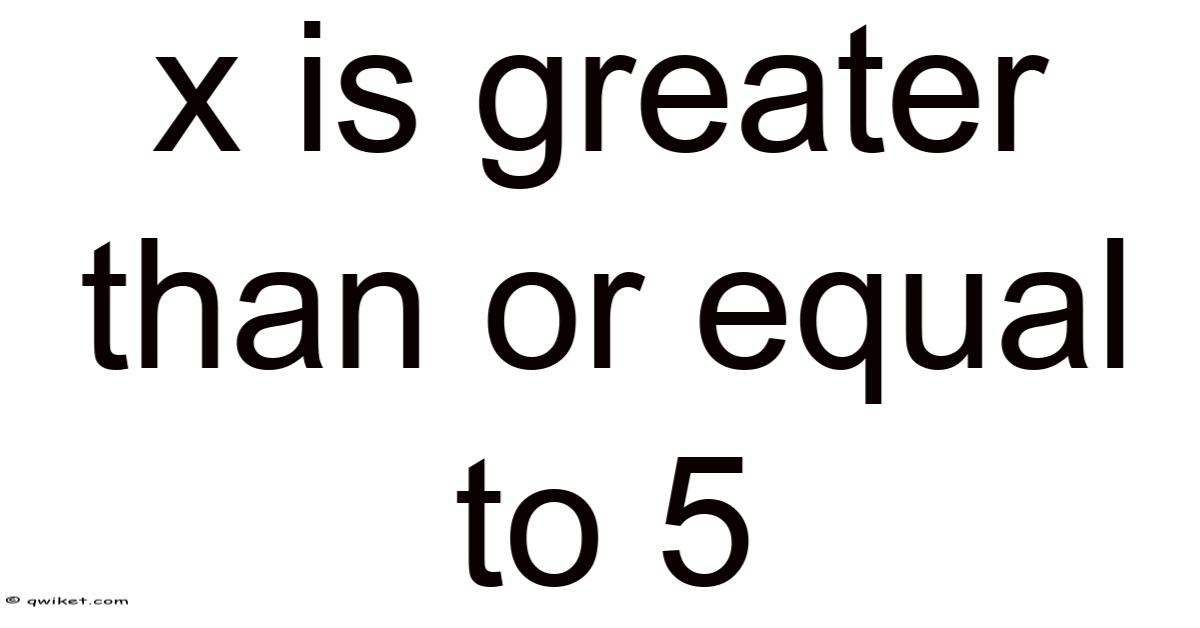
Understanding the Inequality x ≥ 5: A practical guide to Algebraic Expressions
In algebra, inequalities are mathematical statements that compare two expressions using symbols like greater than (>) or less than (<). Even so, one such inequality, x ≥ 5, represents a condition where the variable x must be greater than or equal to the number 5. This concept is fundamental in solving problems involving ranges, constraints, and real-world scenarios. This article explores the meaning, solving techniques, and applications of the inequality x ≥ 5, ensuring clarity and practical relevance for learners of all levels.
What Does x ≥ 5 Mean?
The inequality x ≥ 5 is read as "x is greater than or equal to 5." It indicates that the value of x can be any real number that is either 5 or larger. The symbol "≥" combines two conditions:
- Greater than (>): x must be more than 5.
- Equal to (=): x can also be exactly 5.
This type of inequality is part of a broader category called linear inequalities, which are used to describe relationships where one expression is not equal to another but has a comparative value. Unlike equations, which have a single solution, inequalities often have a range of solutions.
How to Solve the Inequality x ≥ 5
Solving the inequality x ≥ 5 involves identifying the set of values that satisfy the condition. Here’s a step-by-step breakdown:
- Identify the variable and constant: In this case, x is the variable, and 5 is the constant.
- Interpret the inequality symbol: The "≥" symbol means x can take values starting from 5 and extending to positive infinity.
- Express the solution in interval notation: The solution set is written as [5, ∞), where the square bracket includes 5, and the parenthesis indicates that infinity is not a number but a direction.
- Graph on a number line:
- Draw a horizontal line and mark the point 5.
- Shade the region to the right of 5, including the point 5 itself (represented by a closed circle).
- The shaded area represents all valid values of x.
As an example, if x represents the number of hours someone works in a week, x ≥ 5 would mean the person works at least 5 hours. Values like 5, 6, 10, or 100 are all acceptable.
Real-World Applications of x ≥ 5
Inequalities like x ≥ 5 are not confined to textbooks; they appear in everyday situations. Here are some practical examples:
- Age Requirements: A theme park might require visitors to be x ≥ 12 years old to ride a roller coaster. Similarly, x ≥ 5 could represent the minimum age for a specific activity.
- Temperature Thresholds: A weather forecast might predict that temperatures will be x ≥ 5°C during winter, indicating the coldest possible value.
- Budget Constraints: If a company sets a minimum budget of $5,000 for a project, the inequality x ≥ 5 (in thousands) ensures the project meets financial requirements.
- Scientific Measurements: In experiments, a researcher might need a concentration of a solution to be x ≥ 5 grams per liter to achieve desired results.
These applications highlight how inequalities model real-life conditions, making them essential tools in fields like economics, engineering, and data analysis Worth knowing..
Common Mistakes When Working with x ≥ 5
While the inequality x ≥ 5 seems straightforward, learners often make errors. Here are common pitfalls to avoid:
- Misinterpreting the Symbol: Confusing "≥" with ">" can lead to excluding valid solutions. Remember, x ≥ 5 includes 5, while x > 5 does not.
- Incorrect Graphing: Forgetting to shade the correct region or using an open circle instead of a closed one at 5 can misrepresent the solution set.
- Interval Notation Errors: Writing (5, ∞) instead of [5, ∞) omits the inclusion of 5 in the solution.
- Overlooking Context: In word problems, misinterpreting the inequality’s
Overlooking Contextin Word Problems
A frequent oversight is applying the inequality mechanically without tying it to the story’s constraints. Ignoring such hidden limits can lead to absurd answers like “the farmer must harvest 100 bushels,” which the narrative would deem impossible. Now, ” While the mathematical condition is satisfied by any number five or greater, the realistic scenario may impose an upper bound—perhaps the field can only yield 12 bushels due to size limitations. Take this: a problem might state, “A farmer needs to harvest x ≥ 5 bushels of wheat.That's why, always translate the abstract inequality back into the specific context and verify that the chosen values make sense within the given scenario.
Tips for Mastery 1. Read the problem twice – first to grasp the story, then to pinpoint the exact inequality being asked.
- Identify inclusive vs. exclusive language – words like “at least,” “no fewer than,” or “minimum of” signal a “≥” situation, whereas “more than” or “strictly greater than” point to “>”.
- Check the endpoints – when the problem mentions a minimum, the endpoint is usually included; when it mentions a maximum, the endpoint may be excluded or included depending on wording.
- Validate with a test value – substitute a number that should satisfy the condition (e.g., 5, 6, or 10) to ensure the interpretation aligns with the real‑world meaning.
Conclusion
The inequality x ≥ 5 serves as a gateway to understanding how mathematical expressions model real‑world limitations. By recognizing that the symbol denotes an inclusive lower bound, representing solutions in interval notation, and visualizing them on a number line, learners build a solid foundation for tackling more complex constraints. In real terms, avoiding common pitfalls—such as misreading the symbol, mishandling the graph, or neglecting contextual limits—sharpens this skill and prevents misleading conclusions. The bottom line: mastering the nuances of x ≥ 5 equips students and professionals alike to translate everyday conditions into precise mathematical language, fostering clearer reasoning and more reliable decision‑making across disciplines The details matter here..
